
Project: C05

Galectins in the pathogenesis of retinal neovascular and inflammatory diseases

Dysfunctional humoral and cellular innate immunity are key components in the development and progression of age-related macular degeneration (AMD). Retinal microglia, the tissue resident immune cells, play pivotal roles in innate immune responses and regulation of tissue integrity. While a short period of microglia activation supports homeostasis, chronic microglia reactivity represents a driving force for retinal cell death and disease. We have previously shown that polysialic acids form a protective layer on retinal cells and that their binding to microglial receptors is strongly anti-inflammatory, indicating a crucial role for glycoproteins in retinal immunity. In very recent experiments, we demonstrated that galectin-3, a member of the β-galactoside-binding lectin family is strongly upregulated in reactive microglia in retinas of dry AMD patients and in two different corresponding mouse models. In this project, the student will identify the role of dysregulated galectins in AMD with a focus on microglia reactivity, neurodegeneration and neovascularization in the retina. The techniques that will be used to carry out the project will include in vitro and animal models, immunohistochemistry, FISH, ELISAs, RNA analysis, pathway and cell signaling analysis, cell transcriptomics.
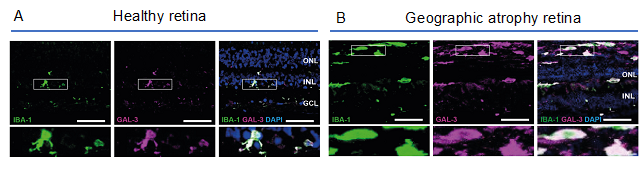

Increased galectin-3 expression in human AMD retinas. A, B Representative images of IBA-1- and GAL-3-stained human healthy (A) and dry AMD retinas with geographic atrophy (B). Inlays show higher magnification. Scale bar: 50 µm. ONL, outer nuclear layer; INL, inner nuclear layer and GCL, ganglion cell layer. Adapted from Tabel et al., Journal of Neuroinflammation 19:29, 2022.


Project-related Publications

X

Wolf A, Clahsen T, Langmann T. The role of human complement factor H in retinal immune response and the prospects for targeted therapy for age-related macular degeneration (AMD). Expert Opin Ther Targets. 2026 Apr;30(4):293-299. doi: 10.1080/14728222.2026.2671685. Epub 2026 May 21. PMID: 42100984 No abstract available.

Min Y, Cuevas-Rios G, Langmann T, Neumann H. Sialylation as a checkpoint for inflammatory and complement-related retinal diseases. Front Cell Neurosci. 2025 Jun 27;19:1623755. doi: 10.3389/fncel.2025.1623755. eCollection 2025. PMID: 40656681 Free PMC article. Review.

Kinuthia UM, Moehle C, Adams RH, Langmann T. Immunomodulation of inflammatory responses preserves retinal integrity in murine models of pericyte-depletion retinopathy. JCI Insight. 2025 Jul 1;10(15):e184465. doi: 10.1172/jci.insight.184465. eCollection 2025 Aug 8. PMID: 40591415 Free PMC article.

Hector M, Behnke V, Dabrowska-Schlepp P, Busch A, Schaaf A, Langmann T, Wolf A. Moss-derived human complement factor H modulates retinal immune response and attenuates retinal degeneration. J Neuroinflammation. 2025 Apr 11;22(1):104. doi: 10.1186/s12974-025-03418-2. PMID: 40217267 Free PMC article.

Kasper M, Karlstetter M, Wildschütz L, Scholz R, Busch M, Bauer D, Meyer Zu Hörste G, Thanos S, Langmann T, Heiligenhaus A. Kinetic changes in microglia-related retinal transcripts in experimental autoimmune uveoretinitis (EAU) of B10.RIII mice. J Neuroinflammation. 2025 Feb 10;22(1):37. doi: 10.1186/s12974-025-03358-x. PMID: 39930455 Free PMC article.

Behnke V, Wolf A, Hector M, Langmann T. C3aR1-Deletion Delays Retinal Degeneration in a White-Light Damage Mouse Model. Invest Ophthalmol Vis Sci. 2025 Jan 2;66(1):15. doi: 10.1167/iovs.66.1.15.

Hector M, Langmann T, Wolf A.: Translocator protein (18 kDa) (Tspo) in the retina and implications for ocular diseases. Prog Retin Eye Res. 2024 May;100:101249. doi: 10.1016/j.preteyeres.2024.101249. Epub 2024 Mar 1. PMID: 38430990.